In short
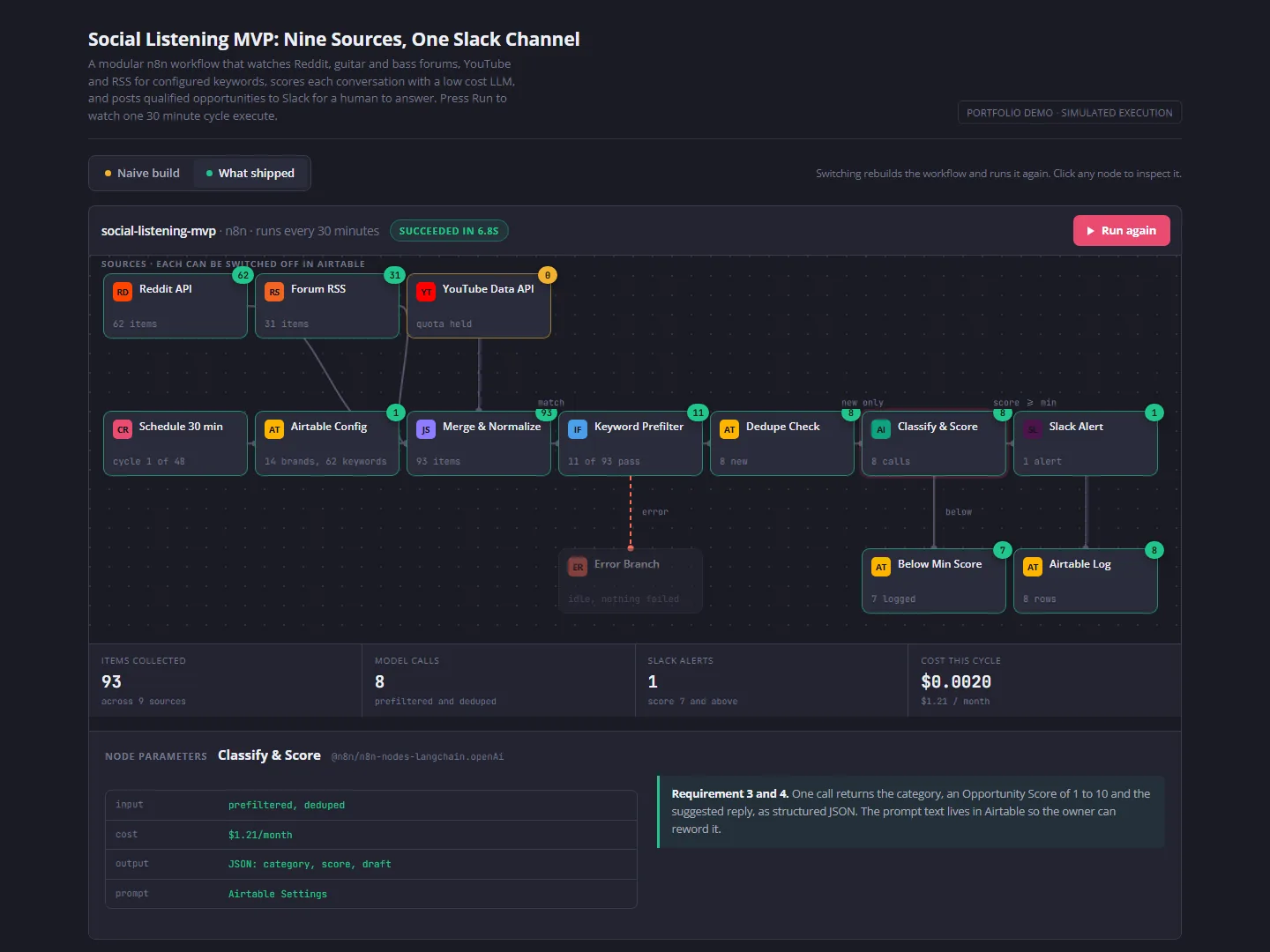
n8n automation MVP that monitors Reddit, guitar forums, YouTube and RSS for buyers who want to switch, built on a $500 fixed budget. Each conversation is classified by an AI model, scored 1 to 10 for switching intent, and posted to Slack with a direct link and a ready draft reply for a human to send. A free keyword prefilter ahead of the AI keeps running cost at $1.21 a month instead of $10.49. Brands, keywords, the AI prompt and the score threshold are all edited in Airtable, with no workflow changes and every API key on the client's own accounts.
Project description
A modular social listening MVP built in n8n on a $500 fixed budget. It watches nine sources (Reddit, forums, YouTube and RSS) for configurable keywords, scores each conversation with a low cost LLM, and posts qualified opportunities to Slack with a suggested reply for a human to send. A keyword prefilter ahead of the model keeps the running cost at $1.21 a month instead of $10.49, and every brand, phrase, prompt and threshold is editable in Airtable without touching the workflow.
Tools & Deliverables
- n8n workflow monitoring Reddit, TheGearPage, TalkBass, YouTube and RSS, structured so new sources drop in without a rebuild
- Airtable control base: brands and competitors, search and complaint and intent phrases, per source on/off switches, editable AI prompt and minimum Opportunity Score
- LLM classification into complaint, fraud, service, fee or policy, leaving, seeking alternatives, neutral, positive or spam, with a 1 to 10 Opportunity Score
- Slack alerts carrying source, author, excerpt, direct link, matched brand, category, score and a ready to send draft reply
- Duplicate prevention and review log in Airtable, basic error handling with retries, a written list of recurring API costs and a Loom walkthrough
The problem
- A monitoring platform's job on an MVP's budget. The brief covered nine sources, AI classification, scoring, draft replies, Slack routing, deduplication and non-technical configuration, with $500 fixed and one to two weeks. Promising all of it at that price is how these projects fail halfway.
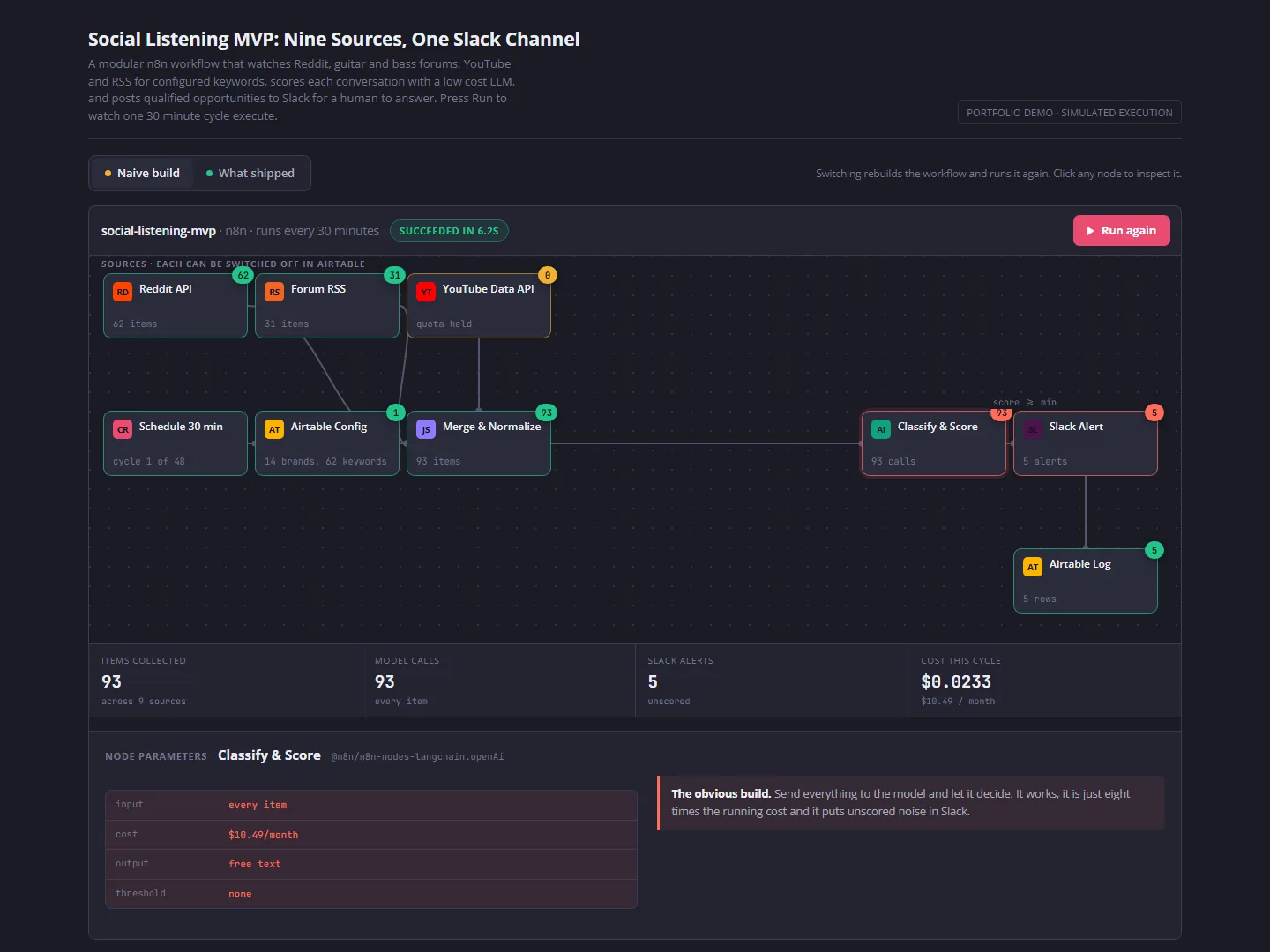
- The obvious build does not fit. Sending all 1,850 items a day straight to a model costs $10.49 a month in API spend and produces 96 unranked Slack alerts a day, which is a channel nobody reads by the second week.
- Two of the named sources have no API. TheGearPage and TalkBass are forums, not platforms with developer programmes, so a naive plan either scrapes them fragilely or quietly drops them from scope.
- YouTube's quota is the real limit. A single search call costs 100 units of a 10,000 unit daily allowance, so a workflow that searches every 30 minutes exhausts the day's quota before lunch.
- X and Twitter had no honest answer in budget. The brief asked for it only if a reliable low cost method existed. It does not: the usable API tier starts around $200 a month, which is 40 percent of the build budget every month.
- The owner is not a developer. Anything that requires opening the workflow to change a keyword, reword a prompt or raise a threshold becomes a support request within a fortnight.
Approach: model the cost before building
The first decision was where the money goes. Rather than picking a model and hoping, I modelled the funnel: nine sources produce roughly 1,850 items a day, and the cost of the system is driven almost entirely by how many of those items ever reach a paid model. Putting a plain text keyword match in front of the LLM cuts 1,850 daily items to 214, an 88 percent reduction that costs nothing to run, because matching against the owner's own keyword list is just string comparison. That single structural choice moves the running cost from $10.49 a month to $1.21 and is the reason the rest of the scope fits inside $500.
Approach: one reliable method per source
Each source got the method it actually supports rather than one generic approach. Reddit runs on its official API under an OAuth app registered to the owner, pulling new posts and comments on each 30 minute cycle. TheGearPage and TalkBass both run XenForo, which publishes an RSS feed per forum, so they are read as feeds with an HTTP fallback rather than scraped. YouTube is treated as quota constrained: searches are scheduled against a daily budget of 24 calls, and comment threads are only fetched for videos that already matched. Everything is flattened into one normalised shape (platform, author, text, URL, post ID) immediately after collection, which is what allows a tenth source to be added later without changing anything downstream.
Approach: structured AI output and deduplication
The AI step does one call per item and returns structured JSON: category, Opportunity Score from 1 to 10, and a short suggested reply. Clear switching intent and active requests for alternatives score highest, which is what the brief asked to surface. Deduplication sits before the model, matching on platform plus post ID with a URL hash for the forums, so a thread resurfacing on the next cycle costs neither a model call nor a Slack ping. Items scoring below the threshold are still written to Airtable rather than discarded, so the owner can lower the minimum score later and see exactly what was being missed instead of guessing.
Solution
The delivered system posts about 23 scored opportunities a day into one Slack channel, each with the platform, the author, an excerpt, a direct link, the matched brand, the category, the Opportunity Score and a draft reply ready to adapt. Nothing posts back to any platform automatically, which is what the brief specified for Phase 1. Duplicate alerts went from 41 a day in the naive design to zero. Everything the owner needs day to day lives in a four table Airtable base: brands and competitors, keywords and complaint and intent phrases, a row per source with an on/off switch, and a settings table holding the classification prompt text and the minimum score. Changing any of those is a row edit, not a workflow change.
Beyond the workflow itself, the handover is what makes it survivable. All accounts, API keys and apps are registered to the owner, so there is nothing to transfer and no dependency on me after delivery. Error handling retries a failing source three times with backoff and then posts to an ops channel, so a source going down is visible rather than a platform silently going unmonitored for a week. The Loom walkthrough covers how the system runs and how to change each setting. The items deliberately deferred to Phase 2 were named in the proposal rather than discovered later: X and Twitter monitoring, automatic replies, and trend dashboards.
The same build in Make.com
The brief allowed Make.com or n8n, and the architecture maps across module for module:
- Schedule trigger becomes the scenario schedule, every 30 minutes
- Reddit API becomes an HTTP module on an OAuth 2.0 connection
- Forum RSS becomes RSS: Watch RSS feed items
- YouTube Data API becomes YouTube: Search videos, on a quota-aware schedule
- Keyword prefilter becomes a filter between modules (text contains, from the Airtable keyword list)
- Dedupe check becomes a Make Data store search and add record, or the same Airtable table
- Classify & Score becomes the OpenAI module with JSON output, parsed with Parse JSON
- Score threshold becomes a router with a filter on the score
- Slack alert becomes Slack: Create a message
- Error branch becomes error handler routes with retries
Why n8n won for this client: billing. Make counts every module operation, so 1,850 items a day passing through several modules each lands well above 100,000 operations a month. n8n Cloud counts a whole workflow run as one execution, so 48 runs a day is about 1,440 executions a month. For a high volume, low value per item workload like social listening, that difference decides the plan tier.
Recurring costs and ownership
The recurring cost list delivered with the build, at current volume:
- LLM (low cost tier): about $1.21 a month
- Reddit API: free, on the owner's own OAuth app
- YouTube Data API: free, inside the 10,000 unit daily quota
- Forum and news RSS: free
- Slack: works on a free workspace
- Airtable: the owner's existing plan; if the high volume log outgrows the free record limit, the log table moves to Google Sheets, which the brief already allowed
- n8n: 48 runs a day fits n8n Cloud's entry tier by execution count, or self-host on a small VPS
Every account, API key, Slack app and paid service is registered to the owner, not the developer. There is nothing to hand back at the end of the contract.
FAQ
How do you decide what fits in a $500 fixed budget?
By modelling the cost before building, not after. The funnel here showed that item volume reaching the model, not model choice, drives running cost, so a free keyword prefilter bought back enough budget to keep all nine sources in scope. The same method decides what gets cut: X and Twitter were removed because the only reliable route costs around $200 a month, which would have eaten the budget every month for one source out of ten.
How is each source monitored, and why not just scrape everything?
Reddit has an official API, so it uses it under the owner's OAuth app. TheGearPage and TalkBass have no API, but both run XenForo, which publishes RSS per forum, so they are read as feeds. YouTube uses the Data API with searches scheduled against its 10,000 unit daily quota. Scraping is the fragile option: it breaks on redesigns and sits in a grey area on most forums' terms, which is a bad foundation for something the owner has to maintain alone.
How do you keep AI cost low without making results worse?
The prefilter removes items that do not contain a single configured keyword, and those are items no classifier would have qualified anyway, so precision is not what is being traded away. One structured call per item then returns category, score and draft together instead of three separate calls. Everything below the score threshold is still logged, so the threshold can be tuned against real data rather than by feel.
How does a non-technical owner manage it after handover?
Through Airtable. Adding a competitor is a new row. Changing the phrases that count as switching intent is editing a field. Rewording how the AI classifies is editing the prompt text in the settings table. Raising or lowering how much reaches Slack is changing one number. Turning a source off is a checkbox. None of those require opening n8n, which is the difference between a system that stays current and one that freezes the day the developer leaves.
What would you add after the MVP?
X and Twitter monitoring once there is a budget line for the API, automatic or semi automatic replies after the draft quality has been judged against real responses for a few weeks, a trend view showing which complaints are rising across competitors, and more communities. The architecture is built for that: sources normalise into one shape, so a new platform is a new input branch rather than a rebuild.