In short
An n8n AI agent that runs a restaurant's WhatsApp. Customers ask for the menu, place an order or book a table, by text or by voice note. The agent reads the live menu from a Google Doc, confirms the order and the total, writes it to a Google Sheets order log, and checks Google Calendar before confirming a reservation. Voice notes are downloaded and transcribed with OpenAI first, so a spoken order is handled like a typed one. Staff edit the menu in a document and see every order in a sheet.
Project description
Restaurants take a large share of their orders and bookings over WhatsApp, and every one of them needs someone to answer: send the menu, take down the order, add up the total, check whether a table is free. At busy times messages wait, orders get copied wrongly and voice notes go unheard. This n8n workflow puts an AI agent on the restaurant's WhatsApp that does all of it, using the restaurant's own menu, order sheet and calendar.
Tools & Deliverables
- WhatsApp trigger on the restaurant's number, with replies sent back in the same chat
- Switch node that separates voice notes from text
- Voice path: media URL lookup, audio download and transcription with OpenAI
- AI agent on an OpenAI chat model with memory, so a customer can order across several messages
- Agent tools: menu lookup in a Google Doc, an order log in Google Sheets, Google Calendar availability and booking, and a calculator for totals
- Order confirmations with the items, delivery address, total and estimated time; booking confirmations with guests, time and requests
The problem
- Staff are busy when customers message. Orders and bookings arrive at the same time as the restaurant is full, so replies are slow or missed.
- Copying orders by hand causes mistakes. Items, addresses and totals typed from a chat into a notebook or system go wrong.
- Voice notes are ignored. Many customers prefer to speak their order, and a text-only bot cannot handle it.
- Bookings need a calendar check. Confirming a table without checking availability leads to double bookings.
Approach
The workflow starts on the restaurant's WhatsApp number. A switch node checks each message: text goes straight to the agent, while a voice note goes through two HTTP steps to get its media URL and download the audio, and OpenAI transcribes it. Both paths reach the same AI agent, so the agent never needs to know whether the customer typed or spoke.
The agent works through tools rather than a long prompt. The menu tool reads a Google Doc, so the menu and prices are always the current ones and staff change them by editing the document. The order tool writes each confirmed order to a Google Sheets log with the contact, delivery address, items, total and date. Two Google Calendar tools check availability and create the booking. A calculator tool adds up the total, so prices are summed rather than guessed. Memory keeps the conversation together, so a customer can ask for the menu, order, and give their address over several messages.
Solution
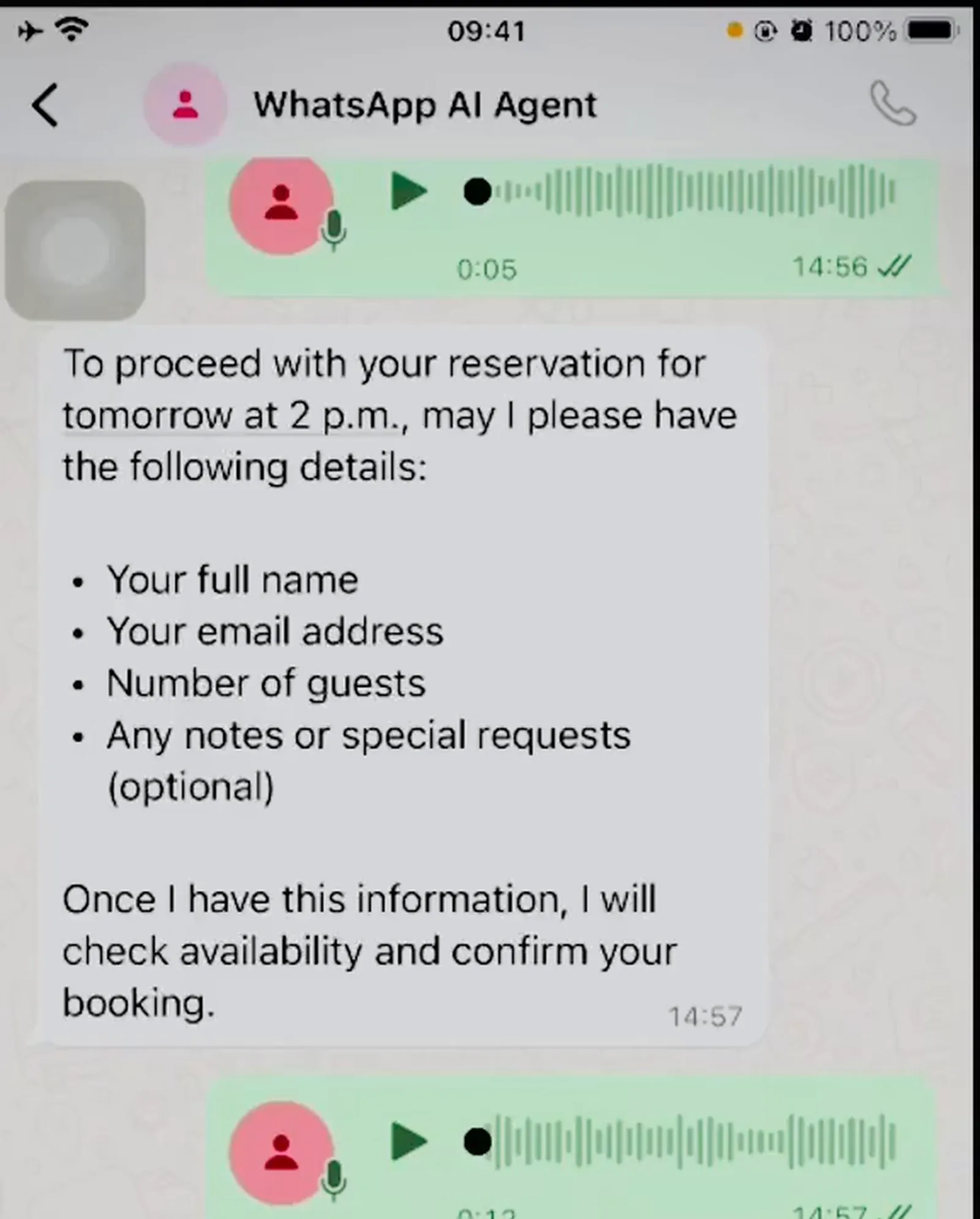
In the demo, a customer asks for the menu by voice note and gets the full menu back with prices. They order two coffees and give their name and delivery address, and the agent confirms the order, the total and an estimated delivery time, then a new row appears in the order sheet. They ask to book a table for two tomorrow at 2pm; the agent collects the name, email, number of guests and any requests, checks the calendar and confirms the booking, noting their request for a window table.
The restaurant gets an assistant that answers at once at any hour, takes orders accurately and never double-books. Staff keep control of the parts that change: the menu document, the order sheet and the calendar. The same structure suits cafes, takeaways, bakeries and catering, and it can send new orders to the kitchen on Telegram or Slack, or connect to a POS or delivery system instead of a sheet.
FAQ
Can customers order by voice note?
Yes. Voice notes are downloaded and transcribed with OpenAI before the agent reads them, so a spoken order is handled like a typed one.
Where does the menu come from?
A Google Doc the restaurant edits. The agent reads it on every request, so new dishes and prices show up straight away.
How are orders recorded?
Each confirmed order is written to Google Sheets with the contact, address, items, total and date. It can also go to a POS or the kitchen.
Can it double-book a table?
It checks Google Calendar for availability before it confirms, and creates the booking as an event.
Does it use the official WhatsApp API?
Yes. It runs on the WhatsApp Cloud API through the restaurant's own Meta business account.