In short
A German trade company ran its dunning process on self-hosted n8n: open invoices from Lexware Office, customer data from Hero Software, reminder letters drafted by an AI agent. Every run finished green while €61,480 of overdue invoices was never chased and other customers were reminded for money they had already paid. I traced the workflow node by node and found four separate faults stacked on top of each other: pagination, German date parsing, the wrong amount field, and an AI agent retyping figures. All four are fixed, with monitoring around the steps that stay human.
Project description
This is a repair job rather than a build. A German trade company ran its dunning process on a self-hosted n8n instance: open invoices pulled from Lexware Office, customer context from Hero Software, reminder letters drafted by an AI agent. Every scheduled run reported success. Meanwhile €61,480 of overdue invoices had never been chased, and customers who had already paid were receiving reminders. Four separate faults were stacked on top of each other, and fixing only the obvious one would not have recovered a single euro.
Tools & Deliverables
- Full trace across n8n execution data, Lexware Office API responses, Hero Software GraphQL queries and the agent's raw outputs
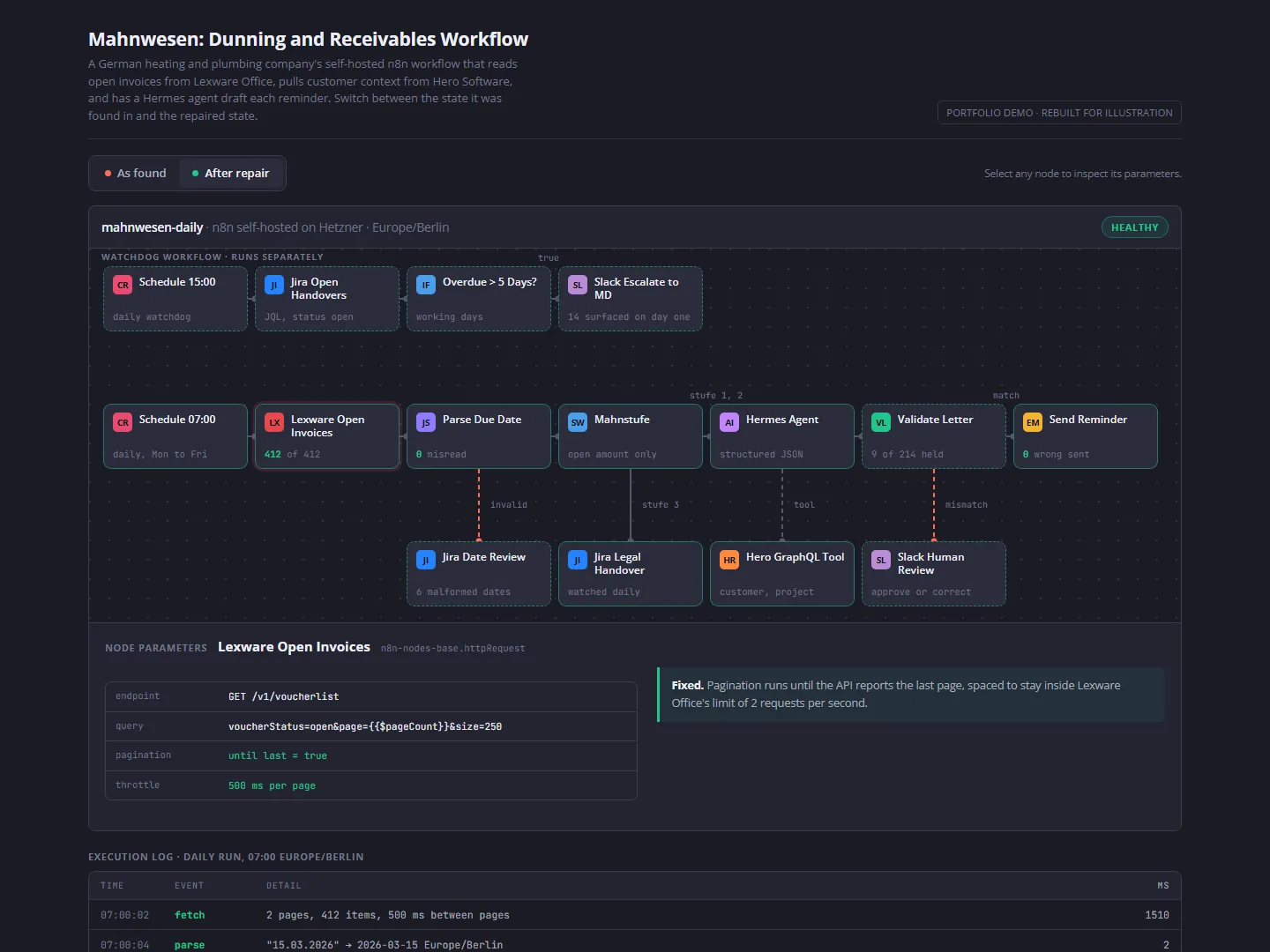
- Paginated, throttled invoice sync covering all 412 open invoices instead of the first 250
- Explicit German date parsing (dd.MM.yyyy, Europe/Berlin) with unparseable values routed to a review queue instead of being skipped silently
- Reminder amounts taken from the open balance rather than the original invoice total, so part-paid customers are no longer chased for the full sum
- AI agent moved to schema-validated structured output, with every figure checked against the accounting system before a letter is sent
- Watchdog workflow that counts working days and escalates stalled legal handovers to the managing director after five of them
The problem
- Receivables growing with no errors anywhere. Every weekday run finished green, so nobody had a reason to look. The only signal the team had was the run history, and it was lying by omission.
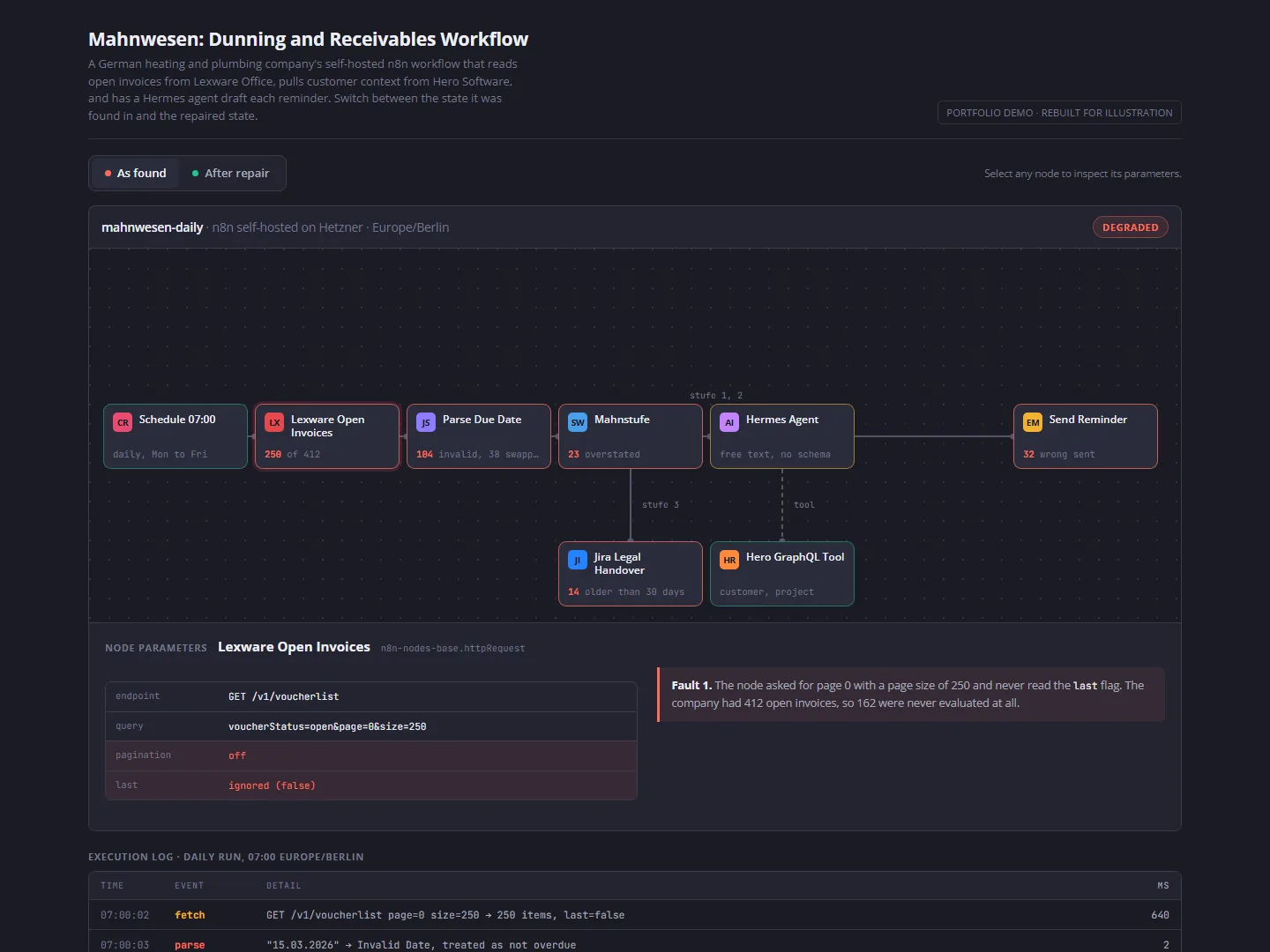
- Only the first page of invoices was ever read. The call to the accounting API asked for page 0 with a page size of 250. There were 412 open invoices, so 162 were never evaluated at all.
- German dates parsed as American ones. Due dates came through as DD.MM.YYYY text and were parsed with the default date constructor. "15.03.2026" became an invalid date, which is never earlier than today, so 104 invoices could never become overdue. "03.11.2026" was read as 11 March, putting 38 more on the wrong schedule.
- Part payments chased at the full amount. The dunning stage used the original invoice total instead of the remaining balance, so 23 customers who had already paid part of an invoice were reminded for the whole sum.
- An AI agent retyping the numbers. The agent wrote each letter as free text and restated the amount in its own words. Replayed against 214 past letters, 9 carried a figure that did not match the accounting record, with nothing checking before sending.
- Legal handovers with nobody chasing them. Invoices reaching the final dunning stage created a task for the managing director. Nothing followed those up, and 14 had been waiting more than 30 days.
Approach
I started from the money rather than from the workflow. Pulling every page of open invoices from the accounting API and comparing those invoice IDs against 30 days of n8n execution data gave a blunt number: 412 invoices open, 250 ever touched. That single count proved the biggest problem sat in the data layer, before any AI step ran, and stopped the investigation from starting with the agent just because it was the newest and most interesting part of the system.
From there it was node by node. The HTTP request for the invoice list had pagination switched off and ignored the flag in the response saying more pages existed. In the code node that parsed due dates, I replayed the stored input strings and reproduced both failure shapes directly: an invalid date for any day above 12, and a silent day and month swap below it. Comparing the dunning stage's expression against the API fields showed the invoice total where the open balance was needed. Finally, replaying 214 historical agent outputs against the matching accounting records surfaced 9 amount mismatches, every one in a letter where the model had restated the figure in prose rather than having it inserted.
The fixes went in as separate changes so each could be verified alone. Pagination loops until the API reports the last page, spaced to stay inside the provider's rate limit. Dates are parsed with an explicit German format and timezone, and anything still unparseable leaves through the node's error output into a review queue for the office team. Amounts come from the open balance. The agent now returns structured JSON with no figures in it, the letter template fills amount, due date and bank details straight from the accounting record, and a validation node compares the rendered letter against the source before anything is sent. A mismatch stops the send and posts the letter, the record and the difference for a human to approve.
Solution
The workflow now evaluates all 412 open invoices every weekday morning. The 87 overdue invoices worth €61,480 that had never been chased were worked through in batches the office agreed to, so the team was not buried in replies on a single morning. Six due dates that were genuinely malformed became review tasks instead of invoices that quietly never got a reminder. Replaying the same 214 historical letters through the repaired pipeline, all 9 bad figures are now stopped at validation, and no wrong reminder reaches a customer.
The part that stays human was kept human deliberately. Deciding to hand an invoice to a lawyer or a collection agency is a judgement call, so the workflow prepares the case and leaves the decision with the managing director. Around that decision sits a separate watchdog: every weekday afternoon it reads the open handovers, counts working days with weekends and public holidays excluded, and sends a message once a case has waited five working days. Its first run surfaced all 14 stale items. On top of that, each run now compares the number of open invoices in the accounting system against the number it actually evaluated and alerts on any difference, which catches the next pagination or filter mistake on the day it happens rather than four months later.
FAQ
How do you find a bug when every run reports success?
By counting instead of reading logs. The logs said success because nothing threw an error, so they had nothing to offer. Listing every open invoice in the accounting system and matching those IDs against a month of execution data turned a vague feeling that receivables were creeping up into a measurable gap with an obvious place to start.
Was it one issue or several?
Four, stacked. Pagination hid 162 invoices, German date strings made 104 more impossible to flag as overdue, the wrong amount field overstated 23 part payments, and the agent retyped amounts in 9 of 214 letters. Fixing only the AI agent, which is where most people look first, would not have recovered a single euro of the €61,480.
Why is an AI agent allowed to write the letter but not the number?
Because the two tasks have different failure modes. A model writing a sentence badly is an editing problem. A model writing a figure badly is a customer being chased for money they do not owe. The agent chooses wording, the template inserts the amount from the accounting record, and a validation step compares the two before sending.
How do you stop this happening again?
Two layers. Every run compares invoices open against invoices evaluated and alerts on a difference, so a future pagination or filter mistake surfaces immediately. And structurally, the agent no longer produces numbers at all, so a model that misreads an amount has nothing to send.
Do you work on workflows you did not build?
Yes, and that is most of this kind of job. The method is the same: establish ground truth from the source system, diff it against what the workflow actually processed, then trace node by node rather than guessing. The repair was delivered against a workflow someone else wrote.